Skip to content


Poshmark is rolling out a new performance-based seller program this fall, and it represents one of the more meaningful shifts to how listings get surfaced on the marketplace.
The concept is simple: Poshmark sellers who consistently ship quickly, fulfill every order, and send items exactly as described will earn greater visibility across the marketplace.
Buyers, in turn, get a clearer signal about who they can trust before they hit the “Buy Now” button.
If you sell on Poshmark, this will affect you greatly, whether you’re a full-time reseller selling 100+ items a month or someone who’s clearing out his closet on weekends for fun.
Here’s everything you need to know about the Poshmark Performance-Based Seller Program.
What’s the New Poshmark Performance-Based Seller Program?
At its core, this is a recognition program tied to Poshmark seller behavior rather than sales volume alone.
Poshmark is essentially formalizing something buyers have always tried to figure out on their own: is this seller reliable? Will my package actually arrive? Will the dress look like the photos?
Instead of leaving Poshmark shoppers to piece that together from love notes and follower counts, Poshmark will help them find reliable sellers with a proven track record.
Poshmark Sellers who qualify get a trust marker on their listings, and their items become easier to find.
The Qualification Criteria for Poshmark New Performance-Based Seller Program
There are two layers to qualifying. First, a one-time threshold you have to cross. Then, ongoing performance you have to maintain.
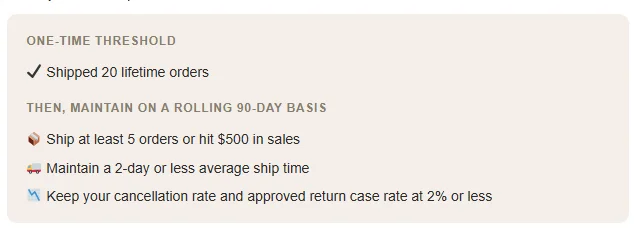
The One-Time Threshold:
Ship 20 lifetime orders. That’s it for the entry gate.
The one-time threshold will filter out new Poshmark seller accounts without much of a track record, but it’s low enough that most active sellers will easily clear it.
The Rolling 90-Day Requirements:
Once you’re past 20 lifetime orders, you have to maintain the following on a rolling 90-day basis:
1. Ship at least 5 orders or hit $500 in sales
2. Maintain an average ship time of 2 days or less
3. Keep your cancellation rate at 2% or less
4. Keep your approved return case rate at 2% or less
The “rolling” part matters. This isn’t a quarterly review where you get graded once and move on.
Your Poshmark stats will be continuously recalculated based on the previous 90 days, which means qualification isn’t permanent.
Slip on ship times for a few days, and you can fall out. Tighten things up, and you can earn it back.
The Sales Volume Requirement Is More Flexible Than It Looks
The “5 orders or $500 in sales” threshold is one requirement worth pausing on, because the or does a lot of work.
A Poshmark seller selling five $20 items a quarter will qualify for the performance-based seller program. So does a Poshmark seller who lists high-end handbags and sells two pieces for $300 each.
Poshmark clearly wanted to avoid a program that only rewards high-volume closets, and this structure accommodates both the fast-turnover reseller and the low-volume luxury seller.
For most Poshmark sellers, five orders across three months is a genuinely modest bar.
Why Ship Time Will Be the Hardest Metric for Most Poshmark Sellers?

A two-day average ship time on Poshmark is achievable, but it demands consistency rather than heroics.
Poshmark technically gives sellers seven days to ship, and most Poshmark sellers have built habits around that window: batching drop-offs, waiting for the weekend, letting a sale sit until it’s convenient.
Those habits will now cost you.
The metric is an average, which cuts both ways. One order that sits for six days can be offset by several same-day shipments.
But it also means a single bad week during a busy stretch can drag your rolling average above the line for a while.
Poshmark sellers who ship the same day or next day as a matter of routine will barely notice this requirement. Sellers who ship in batches on weekends will need to rethink.
Cancellation and Return Rates: The 2% Reality Check
Both the cancellation rate and the approved return case rate are capped at 2% for the new performance-based seller program.
Practically speaking, if you ship 50 orders in a 90-day window, you have room for exactly one cancellation and one approved return before you’re at risk.
This is where accurate Poshmark listings become a business requirement rather than a nicety.
Measurements, flaw disclosure, honest color representation, and confirming an item is still in your possession before it sells are all now directly tied to your visibility.
The most common causes of order cancellations on Poshmark (items that were sold elsewhere, items you can’t find, items you priced by mistake) are all preventable with better inventory management.
Also, note the word “approved” on return cases. Not every case a Poshmark buyer opens counts against you. Only cases Poshmark resolves in the buyer’s favor factor into the metric, which means disputes you win won’t hurt your standing.
What Poshmark Sellers Actually Get from the New Performance-Based Seller Program?
Two things, and they compound.
A Trust Signal on Your Listings
Poshmark buyers browsing your closet could soon see a marker indicating you have a proven track record.
In a marketplace like Poshmark where shoppers are weighing an unfamiliar seller against a familiar retailer, that badge reduces hesitation at the exact moment a buyer is deciding whether to commit.
Search Filtering
Shoppers on Poshmark will soon be able to filter results to show only listings from reliable sellers.
This is the more consequential piece. Filtering doesn’t just make you look better. It makes non-qualifying sellers disappear entirely from that buyer’s results.
Any Poshmark buyer who turns the filter on will remove every unqualified listing from consideration, regardless of price or condition.
How the Poshmark New Performance-Based Seller Program Will Affect Sellers?
Poshmark has always been a discovery-driven platform where sharing, following, and activity influence listing exposure.
The new performance-based seller program will add an operational dimension: your order fulfillment performance will now directly affect your reach.
The likely outcome is a widening gap between sellers who treat Poshmark like a business and those who treat it like an occasional cleanout.
Unqualified listings on Poshmark will soon start to see reduced impressions even if they’re competitively priced. Conversely, qualified sellers will find their items moving faster with less manual sharing.
For serious Poshmark sellers, this is an opportunity. Operational discipline, something within your control, will now convert into visibility.
How Can I Tell If I’m Eligible for Performance-Based Seller Program Program?
You can check where you stand at any point using Posh Stats.
1. Open your profile. In the app, tap the Me tab (your profile photo) at the bottom right. On the web, click your profile photo at the top right.
2. Go to Seller Tools.
3. Under Insights, choose Posh Stats.
4. Look over your Seller Stats to see your eligibility status.
Posh Stats shows your lifetime shipped orders next to your rolling 90-day numbers, making it easy to see how close you are to qualifying.
What Your 90-Day Action Plan Should Be?
Poshmark’s new performance-based seller program will go live in October, which gives sellers roughly 90 days to qualify.
Here’s what your 90-day action plan should be like:
1. Pull your Posh Stats today and identify which metric, if any, is your weak point.
2. Fix your shipping workflow first. Set a rule: every order ships within 24 hours, no exceptions. Keep supplies stocked and identify a drop-off point you pass daily.
3. Audit your active listings. Verify you still physically have every item. Delete or relist anything you can’t locate. Cancellations are the easiest metric to protect and the most damaging to ignore.
4. Tighten your listing quality. Add measurements, photograph flaws directly, and describe condition conservatively. Under-promise on condition, and you’ll rarely see a return case.
5. Use vacation hold properly. If you’ll be away, turn it on. A Poshmark closet on vacation hold doesn’t accrue ship-time damage; an unattended one does.