Skip to content


After more than a year of seller frustration, inconsistent enforcement, and account restrictions that often arrived without warning, Poshmark is ending its excessive listing removal policy.
During a seller webinar, Poshmark announced that its excessive listing removal policy will be discontinued as of July 23, giving sellers the freedom to delete listings again without worrying that it will cost them their Poshmark account.
For anyone who sells across multiple marketplaces, this is not a minor update. It removes a rule that turned an ordinary task like taking down an item that no longer exists into a gamble.
What Exactly Has Poshmark Changed?
The excessive listing removal policy prohibited Poshmark sellers from repeatedly removing and reposting the same or substantially similar items.
Poshmark reserved the right to reduce the visibility of listings from accounts it considered noncompliant, and in more serious cases, to act against the account itself.
As of July 23, that policy goes away. Poshmark sellers can now delete listings as needed, and those deletions will no longer feed into an enforcement system that could throttle their exposure in search or suspend their closet.

Why Did Poshmark Introduce Excessive Listing Removal Policy in the First Place?
Poshmark rolled out the excessive listing removal policy on May 1, 2025, to fix a search-quality problem. Poshmark buyers kept encountering listings they had already browsed, which Poshmark said was eroding buyer trust.
The cause was a widespread tactic: deleting and reposting the same item, so it jumped back to the top of search results, a behavior Poshmark’s own “Copy Listing” feature made easy.
The Poshmark excessive listing removal policy banned repeatedly removing or relisting the same items within 60 days and mass listing removals, whether done manually or through automation, arguing that excessive relisting hurt discoverability and frustrated the community.
Essentially, it was an anti-search-manipulation measure meant to keep Poshmark feeds fresh and varied. So, the intent behind the rule was not unreasonable. The execution is where things fell apart.
How Did the Excessive Listing Removal Policy Affect Cross-Listing Sellers?
Most active resellers do not sell on one marketplace. The same dress is listed on Poshmark, eBay, Mercari, and Depop at the same time, and whichever buyer gets there first wins.
That model only works if the seller can pull the item down everywhere else the moment it sells.
Under the excessive listing removal policy, removing an item because it genuinely no longer existed was a policy violation.
Poshmark sellers reported automated warnings, restricted listings, and account suspensions triggered by nothing more than keeping their Poshmark closets accurate.
The alternative was to leave sold items live on Poshmark and risk a second purchase they could not fulfill, which carries its own penalties for order cancellations.
So, sellers on Poshmark were effectively squeezed between two policies pointing in opposite directions.
Did Poshmark’s Clarifications Fix the Problem?
Not really. Poshmark later explained that sellers were permitted to remove unavailable items and to refresh listings older than 60 days. On paper, that carved out the legitimate use cases.
In practice, the guidance did not come with any visibility into the mechanics. Poshmark sellers had no counter, no dashboard, and no stated threshold.
Nobody knew how many removals were tolerated in a given window, whether the 60-day exception was actually being honored by the automated systems, or what specifically had tripped a warning when one arrived.
What Happened During the November Listing Deletion Incident?
The problem with the excessive listing removal policy was exposed in November 2025, when a technical fault by Poshmark mass-removed listings from a number of Poshmark accounts on its own.
The Poshmark algorithm flagged the affected sellers for excessive listing removals, penalizing them for deletions of listings they had never made.
Poshmark later restored the deleted listings and lifted the temporary restrictions, and to its credit, it moved quickly.
But the episode exposed the structural problem: a bug on Poshmark’s side could escalate into an account penalty on the seller’s side within hours, with no human review standing in between.
When an inventory glitch and a policy violation are indistinguishable to the system enforcing them, the policy itself is the weak point.
How Are Poshmark Sellers Reacting to the Reversal of Excessive Listing Removal Policy?
Most sellers are happy with the announcement that Poshmark removed the excessive listing removal policy, but not everyone is fully satisfied.
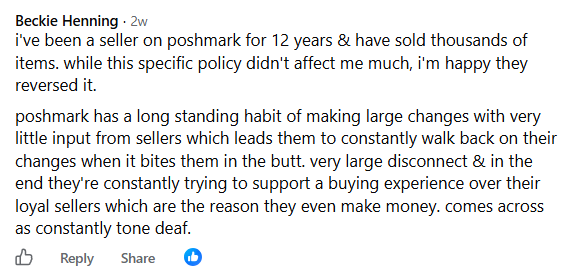
For most Poshmark sellers, the removal of the excessive listing removal policy is a welcome reversal, especially for resellers who cross-list and need to pull an item off Poshmark as soon as it sells somewhere else.
The frustration comes from what already happened.
The excessive listing removal policy was announced with little notice and limited detail on how it would be enforced, followed by fast warnings and suspensions, causing over a year of disruption that further damaged sellers’ trust.
Some Poshmark sellers were flagged by mistake even after being told they would not be penalized for removing items sold elsewhere.
So, the mood is relief mixed with doubt. Poshmark sellers are still debating whether this counts as better late than never, or too little too late.
What Does This Signal About Poshmark and Its Sellers?
Ending the excessive listing removal policy is the right call, and acknowledging that it made resellers’ lives harder is a genuine concession.
The open question is whether the next major change arrives with seller input built in from the start, or whether it follows the same arc: announcement, backlash, damage, and reversal!
Poshmark sellers have made it clear which they would prefer.