Skip to content





That box of old toys in your home could be worth real money. But where you sell it matters as much as what you sell.
The same 1984 Transformer can sell for $40 on one website and $120 on another. The difference is not luck. It comes down to who shops there and what fees you pay.
This guide will show you where to sell vintage toys online in 2026. You will learn how to price your toys, which platform is best for each type of toy, and how much you actually keep after fees.
Know What Toys You Have Before You List
1. Identify the Toy
Identifying a toy accurately is the foundation of valuing it, because every later step depends on knowing exactly what you have. Maker’s marks, copyright dates, and country of origin act like a fingerprint.

Note that a copyright date often shows when the mold or character was registered, not when that particular piece was made, so one toy may carry a date years earlier than its real production.
Country of origin helps narrow this down, since manufacturing moved between places like Hong Kong, Taiwan, China, and Mexico over the decades.
Once you have these details, searching collector databases, auction archives, and fan wikis can confirm the brand, line, and character.
Pay close attention to small differences such as paint colors, misprints, or changes in parts. A rare factory variation can be worth far more than the standard version.
2. Grade the Toy Condition Honestly
Collectors use a few simple terms. Learn them so your listings speak their language:
- MIB / MISB: Mint in box, or mint in sealed box. This is the top tier.
- CIB: Complete in box. All parts are there, but the box was opened.
- Loose complete: No box, but every accessory and part is included.
- Loose incomplete: Missing parts. Still sellable, but for less.
Here is a tip most sellers miss. For many 1970s to 1990s toys, the box and card can be worth more than the toy inside. Never throw out packaging, even if it’s torn.
3. Price with Sold Listings (Not Asking Prices)
Anyone can ask $500 for a toy. What matters is what buyers actually paid.
On eBay, search your toy and turn on the “Sold Items” filter. Look at the last 90 days and match the condition to yours. eBay sellers can also use the free Terapeak tool in Seller Hub for deeper price history.
If your toy shows several sales over $500, or none at all, treat it as a rare piece. Get an expert opinion before you list it anywhere.
Best Places to Sell Vintage Toys Online
1. eBay
eBay is still the first stop for most toy collectors. Serious buyers set saved searches there and get alerts the moment a rare piece is listed.
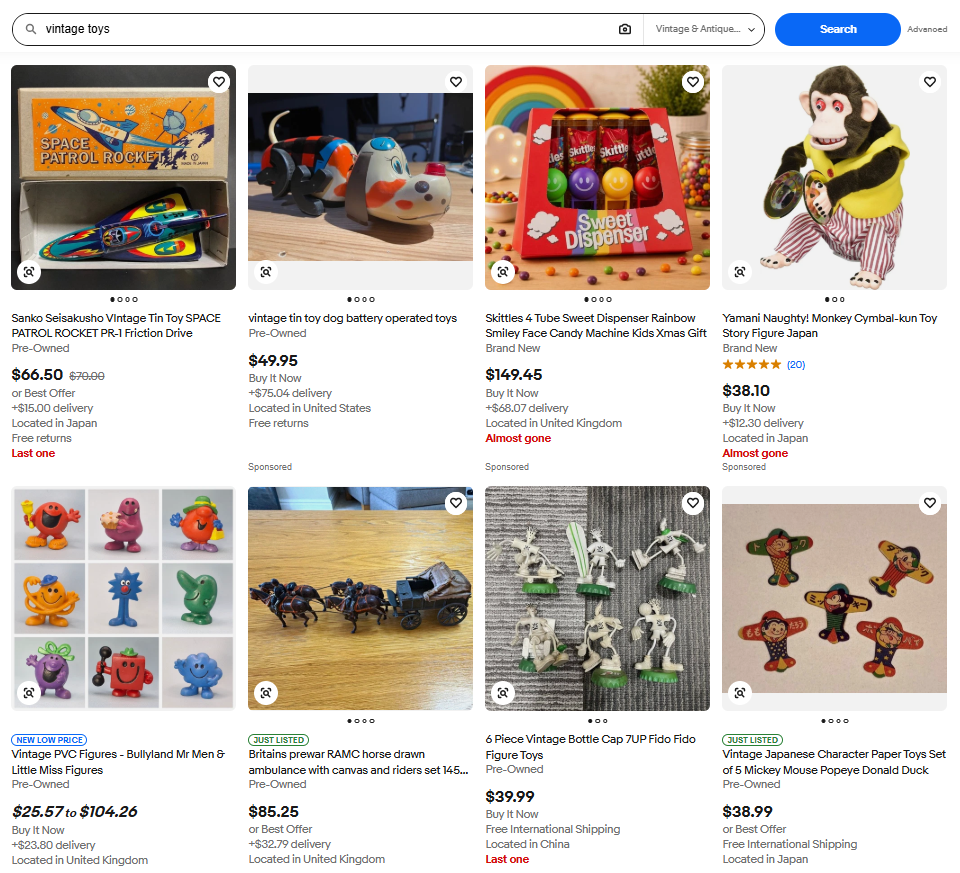
For most toy listings, eBay takes 13.6% of the total sale plus $0.40 per order (over $10). The rate drops to 2.35% on any amount above $7,500. You get 250 free listings each month.
Auction or Buy It Now? This is the biggest choice you’ll make on eBay. Use an auction when many people want the toy and sold prices jump around. Let bidders decide the value.
Use Buy It Now with Best Offer for most other toys. It gives you control, and buyers can still send offers. Set an auto-decline amount so lowball offers never reach your inbox.
Item specifics matter. eBay asks for details like brand, character, franchise, and year. Fill in every one. Collectors filter by these fields, so a blank field can hide your toy from search.
Use the right category. Put vintage figures under Toys & Hobbies > Action Figures & Accessories, not a general toy category. Many collectors browse only the vintage subcategories.
Pro tip: Watch the “watchers” count on your listing. When several people watch a fixed-price toy, send them all a small discount offer. It often turns watchers into buyers within a day.
Best for: Action figures, die-cast cars, video games, and anything collectors search for by exact name.
Watch out for: Heavy competition. You need good photos and exact titles to sell your toys on eBay.
2. Etsy
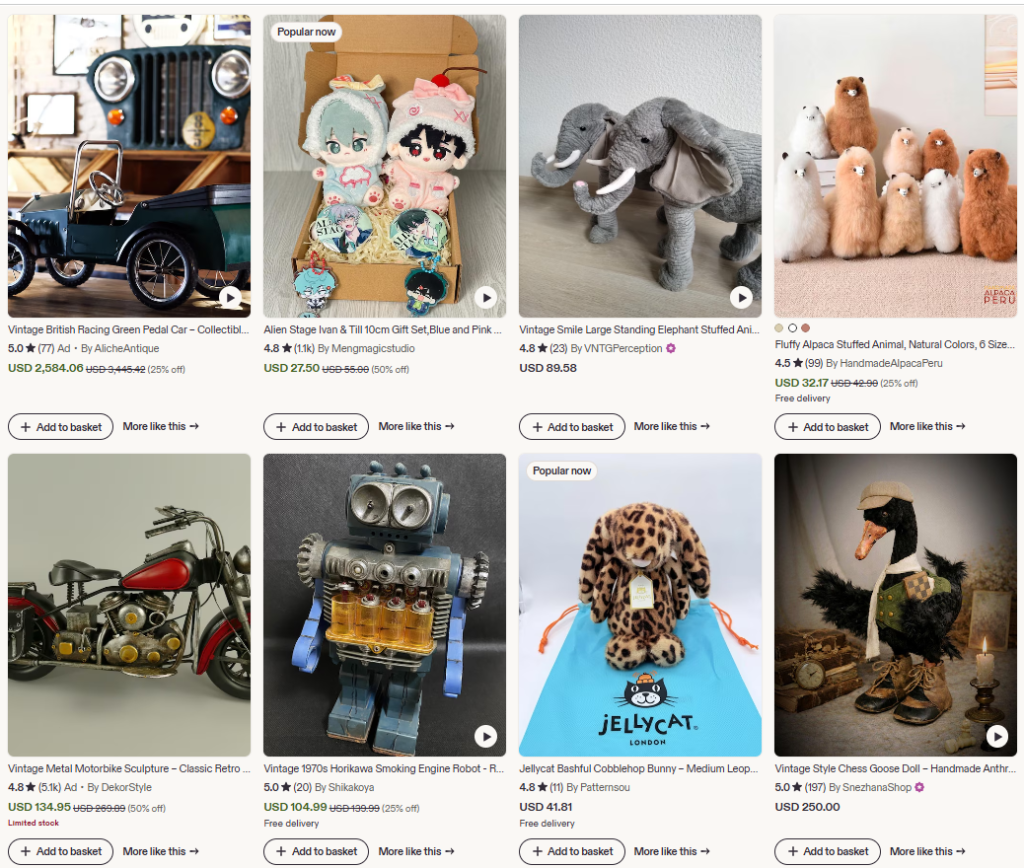
Etsy allows vintage items that are at least 20 years old. Its shoppers often buy for decor, gifts, or nostalgia, not to complete a collection.
Etsy charges a $0.20 listing fee, a 6.5% transaction fee, and 3% plus $0.25 for payment processing. If Etsy sells your item through its offsite ads, you may also pay a 12–15% ad fee on that sale.
Sell the story, not just the toy. Etsy shoppers respond to feeling. A line like “the robot every 1980s kid wanted under the tree” works better here than a list of part numbers.
Style your photos. On eBay, a plain white background is best. On Etsy, a styled shot works well, like a tin robot on a wooden shelf. Include at least one plain shot too, so buyers can see flaws.
Use all 13 tags. Etsy search runs on tags. Mix broad tags like “vintage toy” and “retro gift” with exact ones like “1960s tin robot” and “Fisher Price Little People.”
Know the age rule. Etsy counts an item as vintage only if it’s at least 20 years old. Newer collectibles can get your listing removed, so stick to true vintage here.
Pro tip: List gift-worthy toys in October. Etsy traffic climbs before the holidays, and fresh listings have more time to rank before the December rush.
Best for: Tin toys, wooden toys, vintage dolls, board games, and toys with charming boxes.
Watch out for: Fewer hardcore collectors. Rare, high-dollar figures often sell for less here than on eBay.
3. Mercari
Mercari is easy to use and popular with casual buyers. It charges a flat 10% selling fee on the item price plus any shipping the buyer pays. Listing is free.
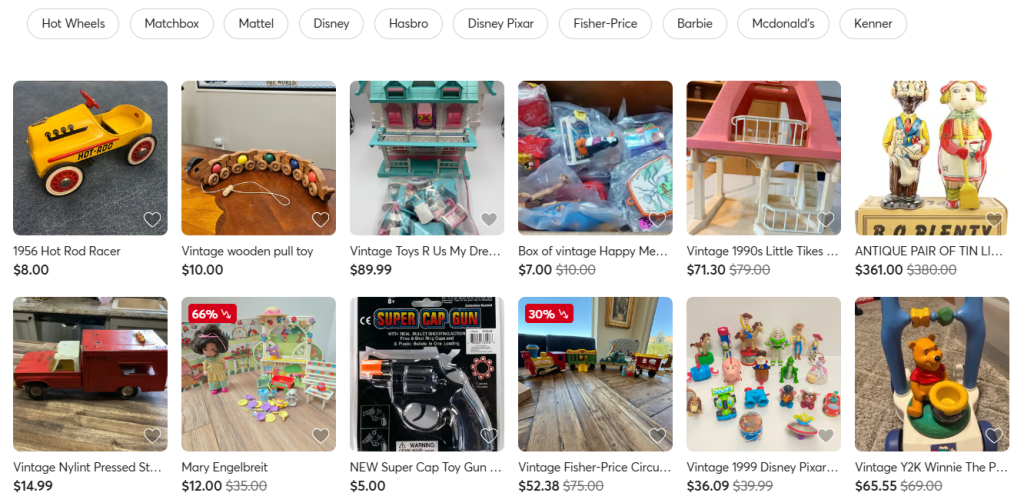
Use Mercari’s built-in boosts. Mercari gives you two free tools to restart interest in a listing:
- Promote: Drop your price by at least 5%. Mercari boosts your listing in search and notifies everyone who liked it. The lower price stays.
- Offer to Likers: Drop the price by at least 10%, and Mercari alerts up to 50 of your most recent likers. The deal lasts only 24 hours.
Price with room to move. Because these tools need price drops, list about 15–20% above your target price. That gives you two or three boosts before you hit your floor.
Bundle smart. Mercari buyers love lots. A group of six loose 1980s figures can sell faster than six single listings, and you only ship once.
Pro tip: Watch your likes. A toy with many likes but no sale is priced a little too high. Send an Offer to Likers before you lower the public price.
Best for: Mid-priced toys in the $15 to $150 range, toy lots, and quick sales.
Watch out for: Buyers who make low offers. Set a firm price floor before you list.
4. Whatnot
Whatnot lets you sell on a live video stream, like a home shopping show. Viewers bid in real time, which can push prices up fast.
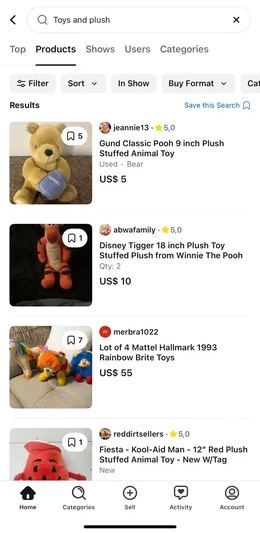
The standard U.S. commission is up to 8%, plus 2.9% and $0.30 for payment processing. Since September 2026, high-volume sellers can earn rates as low as 3%.
You must apply first. Unlike eBay or Mercari, Whatnot makes you apply and get approved before you can sell. Links to your eBay or Mercari shop and clear photos of your inventory help your application.
There’s also a back door. Whatnot says sellers who pass $750 in sales and 25 orders on its Marketplace automatically qualify to go live.
Plan your show like a TV host. Pick a theme, like “80s cartoon figures night.” Line up your toys in order, with cheaper items first to warm up the room and your best pieces near the end.
Use $1 starts with care. Low starting bids pull viewers in, but a quiet room can sell a $60 toy for $3. Start your rare pieces at a price you’d accept.
Show the toy up close. Turn it slowly on camera, point out the maker’s mark, and show any flaws. Live buyers can’t ask for more photos later.
Pro tip: Go live at the same time each week. Regular shows build loyal viewers, and loyal viewers bid more.
Best for: Sellers with lots of inventory, such as action figures, Hot Wheels, and Funko.
Watch out for: It takes time to build an audience. Your first few shows may be quiet.
5. Facebook Marketplace and Collector Groups
Local pickup on Facebook Marketplace costs you nothing in fees. Toy collector groups on Facebook are also full of active buyers who know their stuff.
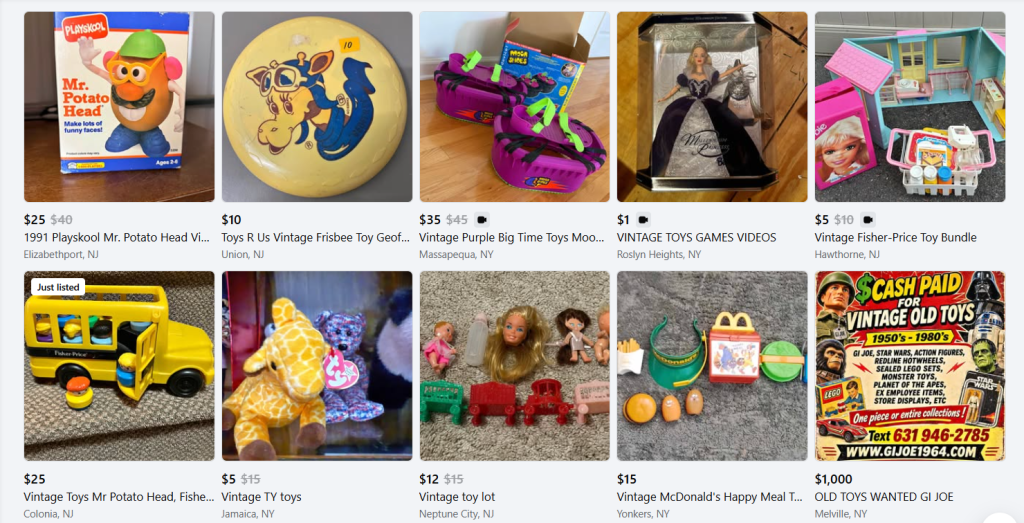
Local pickup vs. shipping. Facebook gives you two ways to sell. Local pickup has no selling fee, so you keep the full price.
Shipped orders paid through Facebook checkout carry a selling fee. Meta has changed this rate several times, so check the current rate before you list.
Join collector groups. Search Facebook for groups like “Vintage Star Wars Collectors” or “Vintage Toys Buy Sell Trade.” These buyers know values and pay fair prices for good pieces.
Read each group’s rules first. Many require prices in the post, ban certain payment methods, or allow sales posts only on set days.
Stay safe. Meet in a busy public place, like a police station parking lot. Count cash on the spot, and don’t let anyone take the toy before you’re paid.
Pro tip: Post a “lot” of mixed toys locally. Parents and casual buyers love grab bags, and it’s a quick way to clear common toys that aren’t worth shipping.
Best for: Bulky toys like Big Wheels, playsets, and toy chests that cost too much to ship.
Watch out for: Scams and no-shows. Meet in a public place and never accept payment methods that a buyer can reverse.
What You Keep From a $100 Vintage Toy Sale
Selling fees look small as percentages. They feel bigger in dollars, so here is the math on one $100 toy (fees on the item price only, standard rates, no ads or promotions).
| Platform | Selling Fees | Fees on $100 | You Keep | Best Fit |
| Facebook Marketplace (local) | None | $0.00 | $100.00 | Bulky toys, local buyers |
| Etsy | 6.5% + 3% + $0.25 + $0.20 listing | $9.95 | $90.05 | Decor and nostalgia pieces |
| Mercari | 10% | $10.00 | $90.00 | Mid-priced quick sales |
| Whatnot | Up to 8% + 2.9% + $0.30 | $11.20 | $88.80 | Live auctions, high volume |
| eBay | 13.6% + $0.40 | $14.00 | $86.00 | Named collectibles, widest reach |
Notice the gap between the cheapest and priciest online option is only about $4. That’s the key insight.
A platform with higher fees but more serious buyers will often earn you more. If eBay gets you $130 for a toy that only fetches $95 on Mercari, eBay wins easily, even after fees.
How to Match Your Vintage Toy to the Right Platform
So how do you choose? Use your toy’s value and size as a simple guide.
- Under $20: Bundle these into themed lots, like “1980s action figure lot.” Sell on Mercari, Facebook, or in a Whatnot show. Single cheap toys rarely cover the cost of your time and shipping.
- $20 to $300: List on eBay as your main store. Then cross-list on Mercari and Etsy (if it’s 20+ years old) to reach more buyers.
- $300 to $2,000: Stick with eBay, where serious collectors shop. Consider professional grading if sold comps show graded copies selling much higher.
- Over $2,000, or one of a kind: Contact a pop culture auction house for a free estimate. Compare their offer to recent eBay sales before you sign.
- Large or heavy: Sell locally on Facebook Marketplace. Shipping a 1970s playset can cost more than the toy itself.
One more factor is timing. Prices often jump when a toy line gets a new movie, show, or anniversary. Holiday season, from November to December, also brings more buyers to every platform.
Tips for Selling Vintage Toys Online
Write Titles the Way Collectors Search
Use this order: brand, line, character, year, and condition. For example: “Kenner Star Wars Boba Fett 1979 Vintage Action Figure Loose Complete.”
Skip filler words like “WOW” or “L@@K.” Buyers don’t search for them, and they waste title space.
Take Photos that Answer Every Question
Shoot in natural light against a plain background. Include the front, back, maker’s mark, and every flaw up close.
Photograph each accessory too. Collectors want proof that small parts, like guns and capes, are original and present.
Don’t Over-Clean or “Fix” Your Toys
A gentle dusting is fine. But repainting, gluing, or swapping parts can lower the value, and you must disclose it.
Pack Like a Pro
Wrap the toy, then box it with padding on all sides. For boxed toys, protect the box corners, since a crushed corner can cut the value fast.
Crosslist to Reach More Buyers
The best way to sell vintage toys faster is to list everywhere your buyers shop. But managing the same toy on four sites by hand is slow, and you risk selling it twice.
That’s where Sidekick Tools helps. You create a listing once and post it to eBay, Mercari, Etsy, Depop, Poshmark, Grailed, and Whatnot.
When the toy sells on one site, Posh Sidekick removes it from the others. It can also send offers to likers/watchers and relist stale listings for you, so your toy listings stay visible.
Common Mistakes to Avoid When Selling Vintage Toys Online
- Pricing from active listings. Asking prices are wishes. Always price from sold listings.
- Splitting a set too early. A complete set can be worth more than its parts. Check sold prices for both before you split it.
- Selling rare toys in a lot. One valuable figure can hide inside a $30 bundle. Check each toy before you bundle them.
- Hiding flaws. Undisclosed damage leads to returns and bad reviews. Show every flaw in photos.
- Guessing shipping costs. Weigh and measure the packed box first. Large boxes can cost more because carriers charge by size, not just weight.
- Listing on only one site. One platform means one audience. Cross-listing puts your toy in front of more buyers.
Frequently Asked Questions (FAQs)
What vintage toys sell best online?
Toys from the 1970s to 1990s with strong nostalgia sell well. Think Star Wars, Transformers, G.I. Joe, Masters of the Universe, and early Hot Wheels. Complete toys with original boxes earn the most.
Is eBay or Etsy better for vintage toys?
eBay is better for collector toys that buyers search for by name. Etsy is better for charming display pieces and toys bought as gifts or decor.
Do I need to get my vintage toys graded?
Only if the toy is valuable and graded copies sell for much more. Check sold listings for graded versus ungraded copies before you pay for grading.
How old does a toy have to be to count as vintage?
Etsy requires items to be at least 20 years old. Many collectors use the same rule, so toys from 2006 or earlier usually qualify to be called vintage toys in 2026.
Can I sell vintage toys on more than one site at once?
Yes, and you should. Just use a crosslisting app to remove the item everywhere once it sells, so you never sell it twice.