Skip to content


If you sell on Poshmark, Mercari, eBay, Depop, or Whatnot, you already know the grind: photograph the item, measure it, research comps, and then sit down to write a listing description that’s accurate, keyword-rich, and compelling enough to actually convert a browser into a buyer. Multiply that by 20, 50, or 200 items per week, and you’ve got one of the biggest time sinks in the reselling business.
In 2026, AI-generated listing descriptions and titles are no longer a novelty — they’re rapidly becoming the standard. Major platforms including eBay and Shopify have already built AI listing assistance directly into their tools.
Thousands of resellers are using AI to write listings in seconds that would have taken them 10 minutes each. And the gap between sellers who use AI and sellers who don’t is widening every day.
This guide breaks down exactly how AI listing tools work, why they matter for resellers specifically, what platforms are already using AI natively, and how to put this technology to work in your reselling business today — without giving up control over your listings.
Why Listing Descriptions Matter More Than You Think
Here’s a fact that should stop every reseller in their tracks: Shopify has publicly noted that across its entire platform, there are millions of products listed for sale with absolutely no description at all. Sellers uploaded photos and set a price — and called it done.
No title optimization. No keywords.
No story that converts a browser into a buyer.
The reselling world has the same problem at massive scale. Listings with vague titles like “Blue Jeans” or “Nike Shirt” get buried in search results.
Buyers scroll past them. They never sell, or they sell for far less than they should.
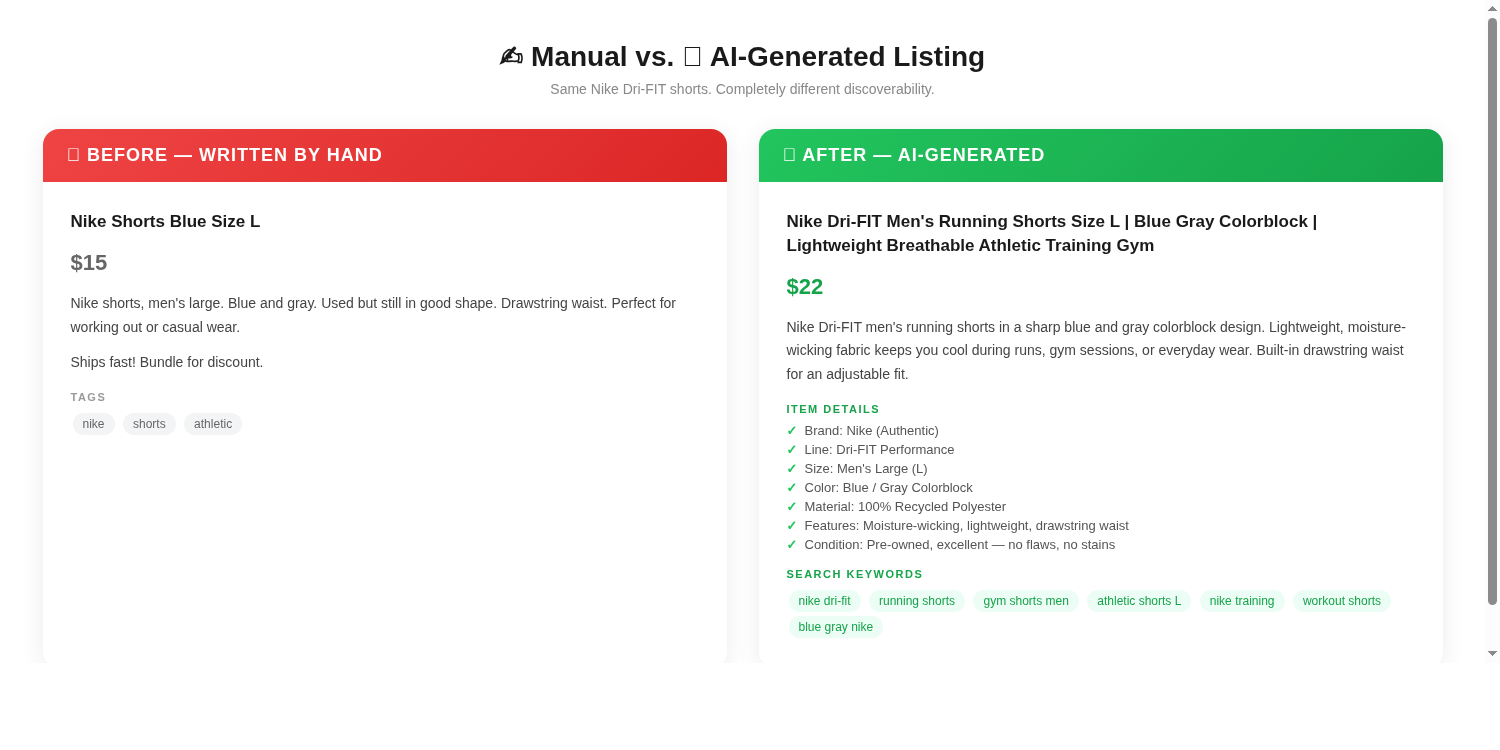
Meanwhile, the seller with a title like “Nike Dri-FIT Men’s Running Shorts Size L Blue Gray Lightweight Breathable Athletic” gets found — because that’s what buyers actually search for.
Your listing title is your SEO. Your description is your sales copy. Neither one can be an afterthought if you want to compete in 2026’s resale marketplace.
The Real Cost of Writing Listings by Hand
Let’s be honest about the math. If you’re a serious reseller listing 100 items per week — a number many full-time resellers hit — and each listing takes you 7 to 10 minutes to write, you’re spending 12 to 17 hours every single week just writing descriptions.
That’s nearly half a full-time job’s worth of hours dedicated to typing the same words in slightly different combinations.
And those descriptions aren’t even guaranteed to be good. When you’re on item 87 out of 100, you’re tired. You’re writing “great condition, no flaws” again. You’re not thinking about what a buyer on Mercari searches for versus what a buyer on eBay searches for. You’re just trying to finish.
This is the problem AI was made to solve.
How AI Listing Generation Actually Works
Modern AI listing tools don’t require you to be a prompt engineer or a tech wizard. The process is straightforward:
- You provide the key details: Brand, item type, size, color, condition, material, style, and any notable features.
- The AI generates: A keyword-optimized title, a full listing description with buyer-friendly language, and in many cases, suggested tags or categories.
- You review and edit: You’re not handing control to a robot. You review, tweak if needed, and publish.
The best AI listing tools are trained on what buyers actually search for on specific platforms. They know that eBay buyers search with highly specific technical terms, while Depop buyers respond to more style-forward, trend-aware language.
A good AI adapts the tone and keyword strategy based on where the listing is going — which is something a tired human typing at 11 p.m. rarely does consistently.
The Platforms Already Using AI for Listings
This isn’t a future trend. AI listing tools are already live on the platforms you’re selling on right now.
eBay
eBay has been one of the most aggressive adopters of AI listing assistance among major marketplaces. The platform has rolled out AI tools that help sellers generate item descriptions from photos and basic inputs — part of what eBay describes as a “magical listing” experience.
The system can auto-suggest item condition, category, and draft a description based on what it identifies in the product image. For eBay sellers listing dozens of items daily, this is already saving hours per week.
Shopify
Shopify launched “Shopify Magic” — its suite of AI-powered commerce tools — with AI product description generation as a flagship feature. The tool is built directly into the product setup page in your Shopify admin.
Type a few keywords or product details, and Shopify Magic generates a compelling description in seconds. According to Shopify, the feature helps merchants with large catalogs “quickly generate enticing product descriptions in a consistent tone across your online store.” It’s included free with paid Shopify plans and works on mobile too.
The message from both eBay and Shopify is the same: AI listing generation isn’t a gimmick. It’s infrastructure. It’s being built into the core of how these platforms work — and resellers who ignore it are fighting with one hand tied behind their back.
What Makes an AI-Generated Title Actually Good?
Not all AI-generated titles are equal. The difference between a mediocre AI title and a great one comes down to how well the tool understands marketplace search behavior. Here’s what a strong AI-generated title does that manual titles often miss:
1. It Includes Buyer Search Terms, Not Seller Assumptions
Sellers often title items based on how they think about them. Buyers search based on how they want to wear or use them. “Vintage denim jacket” is how a seller thinks. “Vintage Levi’s Denim Trucker Jacket 80s 90s Oversized Women’s Size M Distressed” is how a buyer searches.
AI tools trained on marketplace data close this gap automatically.
2. It Maximizes Character Limits
Every major marketplace gives you a character limit for your title. Most sellers use about half of it. AI fills that limit strategically with keywords — brand, style name, size, material, era, color, fit, and more — without making the title sound like keyword soup.
3. It Writes Descriptions Buyers Actually Read
Good AI-generated descriptions anticipate buyer questions. How does it fit?
What’s the material? Are there any flaws?
What does the condition actually mean in real terms? Sellers who answer these questions in their listings get fewer “is this still available?” messages and more “I’ll take it” responses.
AI Listings and Crosslisting: Why They Go Hand in Hand
Here’s where it gets especially interesting for resellers who sell across multiple platforms: every marketplace has a different buyer audience with different search habits and different language expectations.
Poshmark buyers tend to be fashion-forward. They respond to style cues, brand prestige, and trend language. eBay buyers are often more utilitarian — they want specs, model numbers, and condition details.
Mercari buyers fall somewhere in between. Depop skews young, vintage-obsessed, and style-aware.
Whatnot is a live-selling platform where your listing title matters even more because it competes in a stream feed.
Writing separate, platform-appropriate descriptions for each marketplace manually is genuinely impractical at scale. But if you’re crosslisting — posting the same item to 5 or 7 platforms simultaneously — and you have AI-generated descriptions that can be tailored per platform, you’re no longer choosing between speed and quality.
You get both.
This is why tools that combine AI listing generation with crosslisting functionality are increasingly the tool of choice for serious resellers.
The Reseller Skeptic’s Objection: “AI Listings Sound Generic”
This is the most common pushback, and it’s a fair one — in 2022. Early AI writing tools absolutely did produce generic, repetitive descriptions that could have been for any item on any platform. “This beautiful item is in excellent condition and would make a great addition to any wardrobe” is the kind of AI output that rightfully got a bad reputation.
But the gap between then and now is significant. Modern AI listing tools trained specifically on resale marketplace data produce output that is specific, keyword-dense, and natural-sounding.
They know the difference between “good used condition” and what that actually means in a buyer’s mind. They know that “Y2K aesthetic” is a search term on Depop that has commercial intent.
They know that on eBay, brand and model specificity drives traffic more than evocative language does.
The answer to “AI sounds generic” isn’t to avoid AI. It’s to use AI tools built for your specific use case.
AI + Photos: The Full Listing Stack
The most forward-thinking resellers in 2026 aren’t just using AI for descriptions. They’re using AI across the full listing creation process:
- AI background removal — Clean, white-background photos in seconds without a photography setup
- AI stock photo generation — Styled product photos without a model or studio
- AI title generation — Keyword-optimized titles in seconds
- AI description generation — Full listing copy written from basic item details
- Crosslisting — Distribute that listing across 7 marketplaces simultaneously
This is the full reselling tech stack for 2026. Each piece saves time individually.
Together, they transform the economics of a reselling business — turning an operation that required hours of manual work per day into something that can run in a fraction of the time, at higher volume, with more consistent quality.
Tools like Sidekick Tools are built around exactly this philosophy — combining AI-generated titles, AI-generated descriptions, AI stock photos, background removal, and crosslisting to 7 marketplaces into a single platform. The goal is simple: get your items listed everywhere, looking professional, with great copy, as fast as possible.

Real-World Use Case: What AI Listings Look Like in Practice
Take a look at the comparison above. Same Coach handbag, same item details — completely different results. The AI-generated version includes brand, pattern name, bag type, specific material, hardware details, an authentication signal, and condition. Every single word is a potential search term.
The buyer who types “Coach Signature C shoulder bag tan” on Poshmark finds your listing. The buyer who searches “authentic Coach bag brass hardware” finds your listing.
The buyer who types “Coach canvas brown leather purse” finds your listing.
With the manual title? They find someone else’s listing.
How to Get Started with AI Listing Descriptions Today
If you’re ready to test AI listing generation in your reselling business, here’s a practical starting framework:
Step 1: Identify Your High-Volume Categories
Start with the categories where you list the most. If you list 50 clothing items per week, that’s where AI saves you the most time the fastest. Don’t try to overhaul your entire process at once.
Step 2: Give the AI Good Inputs
AI is only as good as what you feed it. Before you generate, note down: brand, item type, size, color, material, condition (and any specific flaws), style (vintage, Y2K, athletic, etc.), and any standout features. The more specific your inputs, the more targeted your output.
Step 3: Always Do a Quick Review
AI generated descriptions are a first draft, not a finished product. Do a 30-second review: check that the item details are accurate, the condition description matches reality, and nothing was hallucinated or misrepresented. Edit what doesn’t feel right. Approve and publish what does.
Step 4: Compare Your Results
Track how items listed with AI descriptions perform versus your historical averages. Look at time-to-sale, final price, and view counts. The data will tell you whether to go all in or continue refining.

The Competitive Reality: Everyone Else Is Already Doing This
Here is perhaps the most important reason to take AI listing generation seriously right now: your competition isn’t waiting.
Power sellers — the ones moving hundreds of items per month — adopted AI tools early. They’re listing faster, listing more, appearing in more searches, and closing more sales.
The resellers still writing everything by hand are competing against sellers who spend a fraction of the time on the same tasks and use those saved hours to source more inventory, research better comps, and scale their operation.
eBay and Shopify didn’t build AI listing tools as a nice-to-have. They built them because the data showed that better descriptions drive more sales, and they wanted their sellers to succeed.
The same principle applies at the individual seller level. Your listing copy is not busywork.
It is a direct lever on your revenue — and AI lets you pull that lever faster and harder than ever before.
Bottom Line: AI Listings Are a Reseller’s Competitive Edge in 2026
Writing listing descriptions is one of those tasks that feels necessary but doesn’t need to be manual anymore. The technology exists, it works, it saves significant time, and it produces better keyword coverage than most humans write consistently under time pressure.
Whether you’re a part-time reseller flipping 10 items a week or a full-time operator running a 1,000-item inventory across multiple platforms, AI listing generation makes your operation leaner, faster, and more competitive.
The question isn’t whether AI belongs in your reselling workflow. The question is how quickly you’re going to start using it.

Try AI Listing Generation Free with Sidekick Tools
Sidekick Tools gives resellers AI-generated titles and descriptions, crosslisting to 7 marketplaces (including Poshmark, Mercari, eBay, Depop, and Whatnot), AI stock photos, background removal, and automation tools — all in one platform. Plans start at $9.99/month, and every new user gets a free 7-day trial with no credit card required.
Stop writing descriptions by hand. Start selling more, in less time.